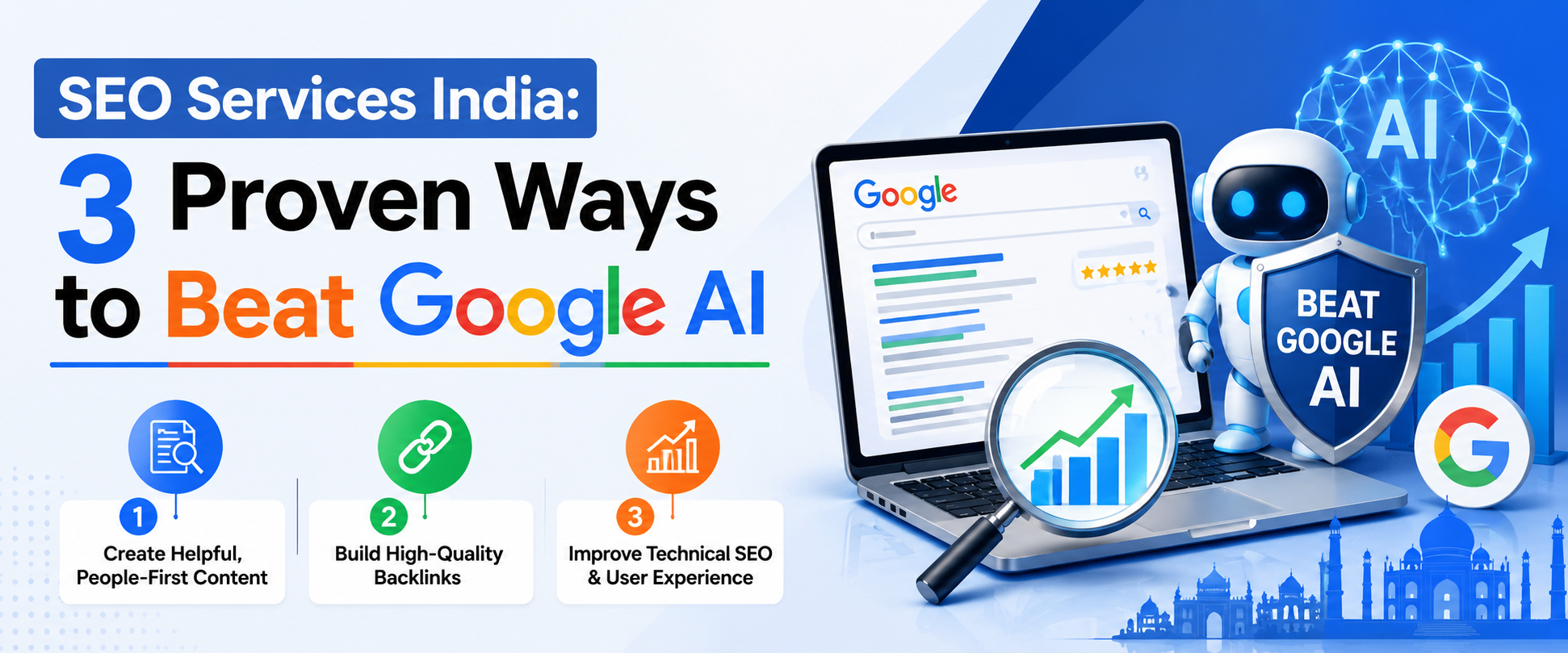
The traditional Google search results page—a neat stack of ten blue links—is fast becoming a relic of the past. If you have searched for anything online recently, you have likely noticed a massive shift in how modern SEO services must operate. A shaded box now sits proudly at the very top of your screen, offering a complete, conversational summary that answers your question instantly without requiring a single click.
Welcome to the era of Google AI Overviews and conversational search (Growbiz Solutions, 2025).
For businesses in India, this transition is both a massive opportunity and a critical wake-up call. According to industry data, AI Overviews now appear for up to 64% of all search queries across desktop and mobile devices (eSEOspace, 2026). Sites that rely purely on old-school keyword placement are watching their organic traffic slip away, with simple informational queries experiencing traffic declines of 20% to 40% (eSEOspace, 2026).
So, how do you keep your business visible when the search engine does the reading for the user? You change the rules of the game.
Forward-thinking SEO experts are no longer just optimizing for algorithms; they are optimizing for artificial intelligence. Here is how professional SEO services India are completely rewriting the playbook to ensure your brand doesn’t just survive the AI search evolution but dominates it.
The Death of the Click? Understanding Zero-Click Search in 2026
To understand why your digital strategy needs an upgrade, you have to look at how user behavior has fundamentally transformed. In the past, a user typed a phrase, clicked a top link, scanned the webpage, and found their answer. Today, Google’s Gemini-powered engine does the heavy lifting for them: it reads the top-ranking pages, extracts the most reliable facts, and synthesizes a unique response directly on the search results page (Myidcm, 2025).
This has accelerated a phenomenon known as “Zero-Click Search” (Myidcm, 2025). When users get a precise, complete answer immediately, they have less incentive to click through to an external website.
| Search Aspect | Traditional SEO | AI-First SEO (2026) |
| Query Engine | Keyword-matching index | Generative & Answer Engine |
| Primary Goal | Rank #1 in the blue links | Become the cited source inside AI Overviews |
| User Interaction | Click, read, and browse | Converse, refine, and convert |
| Content Metric | Keyword density & length | Context, depth, and entity trust |
Source: Industry consensus on Generative Engine Optimization (GEO) standards (Growbiz Solutions, 2025; Tangence, 2026).
While this sounds intimidating, an experienced SEO agency views it as a major win. Why? Because the remaining traffic is incredibly high-intent. When a user reads an AI summary and still clicks on a cited link, they are much further along in their buying journey (eSEOspace, 2026). They aren’t looking for basic definitions—they are looking for an expert to solve their problem.
From Keywords to Entities: How AI Evaluates Your Worth
If you are still hiring content writers to sprinkle a specific phrase into a blog post five times, you are playing a game that ended years ago. Modern AI search engines do not look for exact word matches; they look at entities and context (Growbiz Solutions, 2025; Tangence, 2026).
An entity is a clearly defined concept, brand, person, or place. When an AI search engine processes a query, it maps out how different entities relate to one another (Glowing Digital, 2026).
Real-World Example: If a user searches for “best enterprise payroll software in India,” Google’s AI doesn’t just look for websites that repeat that phrase. It cross-references third-party reviews, legal compliances mentioned on the site (like EPFO or tax laws), and team credentials to verify if the business is a genuine, trusted entity in the fintech space (nasscom, 2026).
To build this level of systemic trust, top SEO services focus on building a robust content architecture. Instead of producing isolated, shallow blog posts, they construct deep “Topical Clusters” (Growbiz Solutions, 2025; Tangence, 2026). This involves creating a comprehensive pillar page that defines a major industry topic, supported by highly detailed sub-pages that address specific user problems, all tightly woven together with logical internal links (Tangence, 2026).
The AI-Ready Content Blueprint: Becoming “Citation-Worthy”
To get your brand featured as a trusted source inside a Google AI Overview, your content must be structured so clearly that a machine can easily parse, verify, and quote it (Myidcm, 2025). This new discipline is called Generative Engine Optimization, or GEO (Myidcm, 2025; eSEOspace, 2026).
When you work with professional SEO experts, they transform your website content using a highly structured, modular blueprint:
1. Lead with the Direct Answer
Do not bury the lede under fluffy introductions. If a section answers a question, place a direct, clear answer of 50 to 80 words right at the top (Growbiz Solutions, 2025; MindStudio, 2026). AI language models love plain-language answer blocks that they can easily lift and present to the user (EnFuse Solutions, 2026).
2. Embrace Data and Original Insights
AI models can synthesize generic definitions easily, but they cannot replicate original human experience, proprietary data, or specialized case studies (Tangence, 2026). Including unique statistics, original research, and first-hand business insights makes your page highly “citation-worthy” (eSEOspace, 2026).
3. Use Highly Scannable Formatting
Densely packed paragraphs are incredibly difficult for both humans and AI bots to digest efficiently (MindStudio, 2026). Break down complex concepts using clean data tables, concise bullet points, and numbered lists (Myidcm, 2025; MindStudio, 2026).
Double Down on E-E-A-T (Experience, Expertise, Authoritativeness, Trustworthiness)
Because the internet is flooded with low-grade, fully automated AI text, search engines have strictly raised their quality bars (Tangence, 2026). Google wants to ensure that the sources it recommends are safe, authentic, and written by real people with real expertise (Tangence, 2026).
This is why Professional SEO Services focus heavily on reinforcing your brand’s E-E-A-T signals (Spinta Digital, 2025):
- Experience: Showcase actual photos of your team, real client case studies, and step-by-step videos of your workflows in action (Tangence, 2026; Mocaup, 2026).
- Expertise: Highlight author credentials, clear biographical backgrounds, and professional certifications directly on your pages (Spinta Digital, 2025; MindStudio, 2026).
- Authoritativeness: Build a healthy digital PR footprint by earning high-quality backlinks and brand mentions from highly respected industry platforms and local news outlets (Spinta Digital, 2025; Mocaup, 2026).
- Trustworthiness: Maintain clear contact information, accessible terms of service, secure HTTPS protocols, and transparent pricing structures (Spinta Digital, 2025; Mocaup, 2026).
Why India Needs a Tailored AI Search Strategy
Optimizing a brand for the Indian market comes with its own unique set of cultural and technological dynamics. India is a mobile-first nation, with a massive portion of the population accessing the internet exclusively through smartphones (Mocaup, 2026).
Furthermore, search patterns across the country are deeply complex and highly multilingual. Millions of Indian users leverage voice search and type queries using “Hinglish” or other regional combinations (Mocaup, 2026).
Because voice search is naturally conversational, queries sound less like rigid keywords and more like real-life questions (Glowing Digital, 2026). An expert SEO agency in India tackles this by incorporating localized FAQ frameworks and structured schema markup, ensuring your business stays visible whether a user is searching in English, Hindi, or a mix of both (Mocaup, 2026).
Frequently Asked Questions (FAQs)
What is the main difference between traditional SEO and AI search optimization?
Traditional SEO focuses heavily on matching exact keywords and earning backlinks to rank in a static list of blue links. AI search optimization, or Generative Engine Optimization (GEO), focuses on context, structured data, and building topical authority so that your content is selected as a trusted, cited source inside conversational AI summaries (Myidcm, 2025; eSEOspace, 2026).
Will AI-generated search overviews completely kill website traffic?
No, but it does change the type of traffic you receive. While simple informational queries (like definitions) see lower click-through rates, users who click on a source inside an AI Overview possess much higher purchase intent and arrive at your site with much deeper context (eSEOspace, 2026).
How can a business in India start optimizing for Google AI Overviews today?
The fastest way to start is by restructuring your existing content. Update your pages to answer common consumer questions directly within the first few paragraphs, implement proper FAQ and LocalBusiness schema markup, and back up every single business claim with real-world data and expert author bios (Spinta Digital, 2025; Growbiz Solutions, 2025).
Conclusion: Partner with the Right Experts for the Future of Search
The digital landscape is moving incredibly fast, and chasing short-term algorithmic tricks simply will not cut it anymore (Tangence, 2026). To keep your brand visible, credible, and growing, you need an ongoing, intelligent strategy that treats search engines like the sophisticated answer tools they are (nasscom, 2026).
At our core, we don’t just optimize for static pages—we build future-ready digital authorities. Our dedicated team combines deep technical knowledge, advanced semantic structuring, and authentic, human-first storytelling to ensure your business thrives in both traditional rankings and cutting-edge AI environments.
Ready to future-proof your digital presence? Contact our SEO experts today for a personalized AI-readiness audit and discover how our tailored professional SEO services can scale your business.